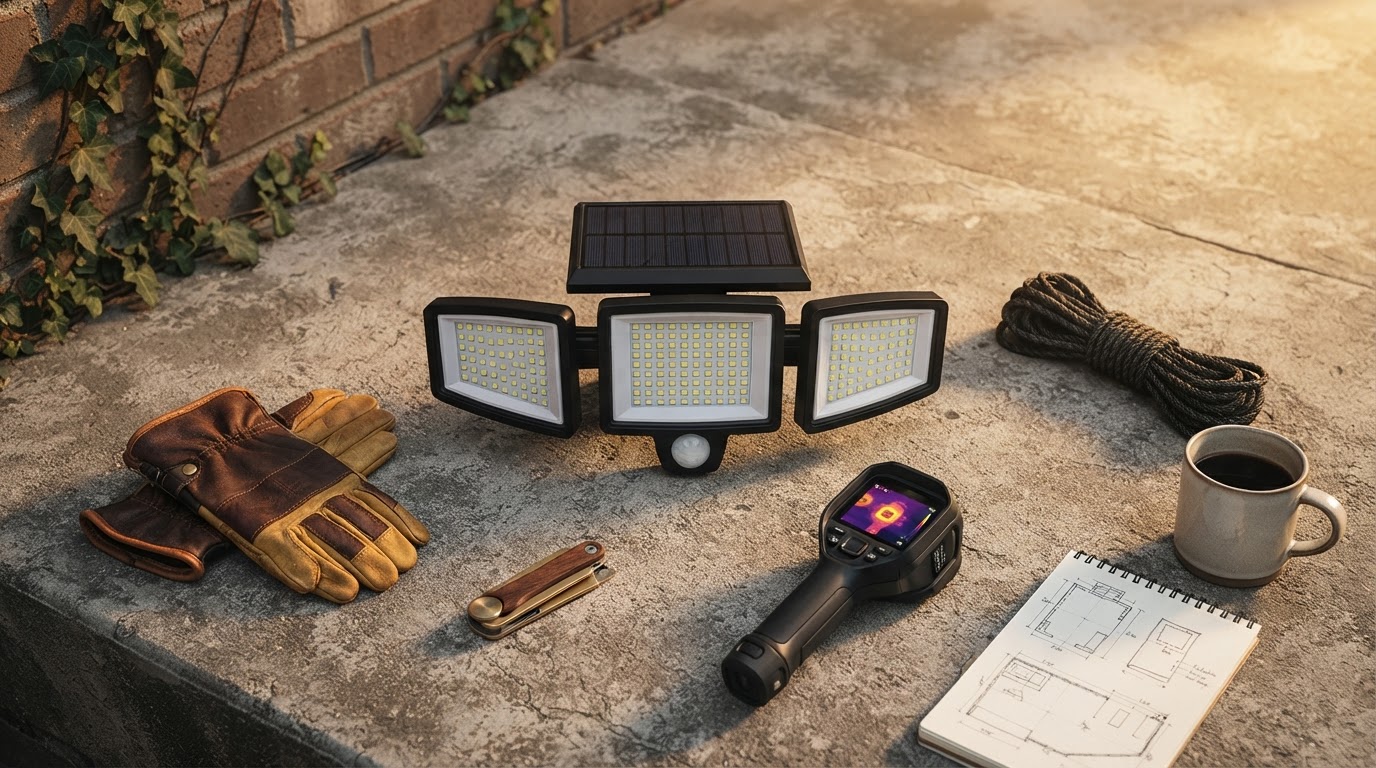
Solar Motion Sense Light and Perimeter Efficiency
 Maya ChenContributing Editor
October 20, 2026. This analysis examines the technical limitations and practical deployment of Solar Motion Sense Light systems for residential properties. It is intended for homeowners who prioritize measurable security outcomes over decorative lighting aesthetics.
The Failure of High-Lumen Saturation
The conventional wisdom says that more lumens necessarily equal better security. However, this ignores the thermal and battery constraints inherent in photovoltaic hardware. According to the product testing data at Nature Power, even integrated LED triple-head units must balance high output with battery cycle life to remain functional through consecutive cloudy days. When consumers install high-draw floodlights, they often find the units depleted by 3:00 AM, precisely when security is most critical. This vulnerability is why dusk to dawn solar motion lights require a more sophisticated power management profile than simple on-off toggles. Here's the part nobody talks about: a 2000-lumen light that dies halfway through the night is objectively inferior to a 500-lumen light that maintains its charge. Most "budget" solar motion sensor lights outdoor use lead-acid or low-density lithium batteries that cannot sustain the discharge rates required for frequent motion triggers in high-traffic areas. This leads to a false sense of security where the hardware exists but the energy to power it does not.
Technical Integration of Solar Motion Sense Light
Solar Motion Sense Light addresses the power-to-performance gap by utilizing hyper-efficient PIR (Passive Infrared) sensors that minimize standby current. Unlike active sensors that emit energy to detect change, these units wait for heat signatures, preserving the battery for the actual illumination event. This efficiency is vital when deploying weatherproof solar motion detector lights, which must operate in temperatures that naturally degrade battery chemistry. Run the math: if a standard solar light consumes 50mA in standby, it can drain a small battery by 20% before it even detects a person. Solar Motion Sense Light hardware targets sub-10mA standby draws. This allows for the inclusion of solar powered security lights with motion sensor capabilities that actually last through a full winter cycle. Furthermore, the detection range is a fixed variable that many manufacturers overstate. While some Classy Caps units report detection from 15 to 50 feet, the reliability of that detection drops off significantly at the margins. Solar Motion Sense Light prioritizes a 120-degree arc with a 25-foot hard-trigger zone, ensuring that the light activates when a threat is close enough to be identified by secondary camera systems, rather than triggering on distant street traffic.
The Strategic Deployment Framework
Effective outdoor lighting is a matter of placement logic rather than raw quantity. When installing solar wall lights for patio security, the height of the sensor determines the cone of detection. Mounting a light too high increases the range but decreases the sensitivity to ground-level movement. Conversely, low mounting creates blind spots. Homeowners should evaluate their perimeter using a tiered approach that prioritizes entry points over general yard illumination. This is especially true for solar powered security lights with motion sensor configurations where the solar panel orientation is fixed. If the panel does not receive at least six hours of direct solar radiation, the motion sensor's recovery time—the time it takes to recharge after an activation—will exceed the frequency of night-time triggers. Before finalizing an installation, use this technical checklist:
- Verify the PIR sensor has a clear line of sight, unobstructed by glass or foliage which blocks infrared heat signatures.
- Calculate the solar window of the installation site to ensure a minimum of 500mAh of daily harvest per 100 lumens of output.
- Test the trigger delay; any lag over 0.5 seconds allows an intruder to move through the light's primary focal point before it activates.
- Check the IP rating; outdoor solar motion sensor lights outdoor require at least IP65 to prevent internal condensation from short-circuiting the sensor board.
- Align the solar panel at a 30-to-45-degree angle facing south to maximize photon collection during the shorter days of the year.
Shop Solar Motion Sense Light here