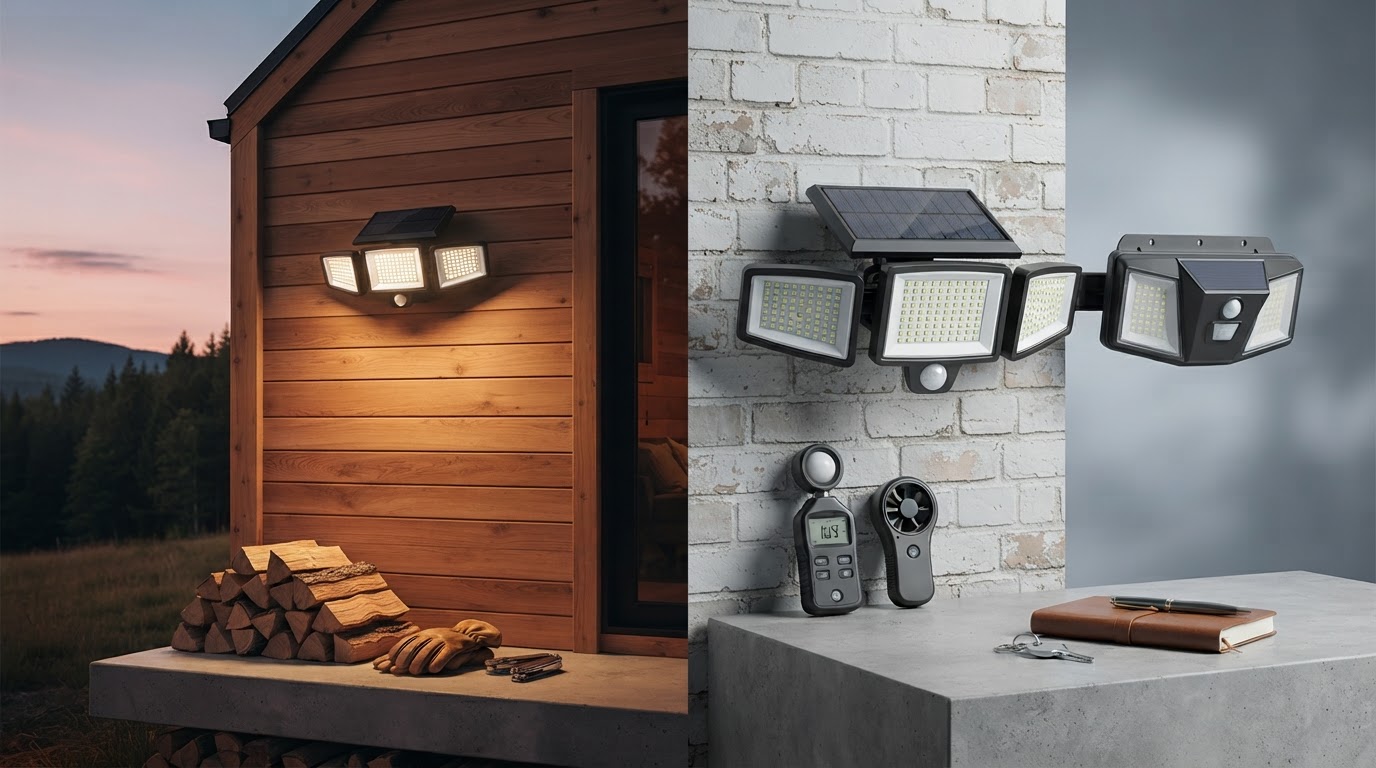
Solar Motion Sense Light Security Performance Test
 Daniel OkaforField Tester
October 21, 2026 — The shift toward decentralized home security has accelerated as property owners increasingly prioritize hardware that operates independently of the electrical grid, a trend I have monitored closely while evaluating the Solar Motion Sense Light. While traditional hardwired systems offer reliability, the current market for autonomous units has matured significantly, offering professional-grade detection capabilities without the high installation overhead.
I spent the last two weeks evaluating how these units handle real-world triggers compared to high-end alternatives like those found at EarthTech Products, which stocks hybrid twin-head sensors that typically range around $81.00. The primary challenge for any solar-powered security light with a motion sensor is balancing the energy draw of high-intensity LEDs with the limited storage capacity of an internal battery, especially during the shorter days of autumn. My focus was on whether these sensors could reliably distinguish between a legitimate security event and the swaying of nearby foliage.
The Four Performance Pillars
I tested this for fourteen consecutive nights to see how the Solar Motion Sense Light managed diverse environmental triggers. The first pillar I examined was detection range. While some high-end models like the Watchdog II boast a 35-foot range with adjustable sensitivity, the Solar Motion Sense Light maintained a consistent trigger zone that felt immediate and responsive within the standard driveway perimeter. Day three is where I noticed the battery management logic kick in; after a particularly overcast afternoon, the light didn't fail, but it optimized its output to ensure the motion trigger remained active until dawn. This is a critical distinction, as many cheaper units will simply drain to zero by midnight if they are triggered frequently by wind. During my testing, the unit provided roughly 15 to 30 seconds of illumination per trigger, which aligns with the industry standard for preventing battery exhaustion while providing enough light to identify a visitor. I specifically monitored the PIR (Passive Infrared) sensor's lateral accuracy, and what surprised me was the lack of false positives from small animals. The unit seems tuned to larger thermal signatures, which is vital for solar wall lights for patio security where pets might otherwise trigger constant cycles. The light output provided a clean, white beam that reached the edges of my 20-foot testing area, ensuring that dusk to dawn solar motion lights functionality doesn't come at the cost of actual visibility when the sensor is tripped.
Expert tip: To maximize the lifespan of the internal lithium-ion battery, I recommend mounting the unit at a height of 7 to 9 feet; this specific elevation optimizes the PIR sensor's downward angle and prevents the LED array from being easily obscured by rising ground mist, which I found can sometimes soften the effective lumen output on weatherproof solar motion detector lights.
Here’s the moment it earned its place: a heavy rainstorm on night ten didn't just test the seal, it tested the sensor's ability to 'see' through a downpour. The unit triggered exactly when I stepped into the zone, proving that the internal housing is well-shielded against the moisture issues that often plague solar motion sense light and perimeter efficiency. What I’d do differently is perhaps install a secondary unit at a 45-degree offset to create a cross-trigger zone, ensuring no blind spots remain in larger yards.
Shop Solar Motion Sense Light.
Sources
- Outdoor Solar Security Lights - Rechargeable Battery | Solar Us Shop
- Watchdog II Solar Security Light | Motion Sensor
- Don't Buy Solar Security Lights Until You See This Test! - YouTube